

If you receive an SNGPL gas bill every month and feel confused about why your gas rate suddenly jumps, the answer usually lies in one thing: your consumer category. Under official government notifications, domestic gas consumers are divided into protected and non-protected categories. This classification directly controls how much you pay per unit and what fixed charges apply.
In this guide, I’ll explain the SNGPL protected category using official tariff information, show how it differs from the non-protected category, and help you understand exactly where you stand as a domestic gas consumer in Pakistan.
What Is the SNGPL Protected Category?
The SNGPL protected category applies to domestic gas consumers whose gas usage stays within a defined limit. According to the official notification, a consumer qualifies as protected if their average gas consumption during the last four winter months (November to February) is equal to or below 0.9 hm³.
Protected consumers are charged lower gas rates and lower fixed monthly charges. This category exists to protect low-usage households from high gas prices, especially during winter.
In simple words, if your household uses gas carefully and stays within limits, SNGPL considers you a protected consumer.
What Is a Non-Protected Gas Consumer?
A non-protected gas consumer is any domestic consumer who does not meet the protected category criteria. If your average winter consumption exceeds 0.9 hm³, or if your current monthly usage crosses protected slabs, you fall into the non-protected category.
Non-protected consumers:
- Pay much higher per-unit gas rates
- Pay higher fixed monthly charges
- Experience sharper bill increases with rising consumption
This category typically includes households with heavy heater usage, large families, or inefficient appliances.
Official Gas Rates for Protected vs Non-Protected Consumers
The difference between the two categories becomes very clear when we look at the official gas sale prices.
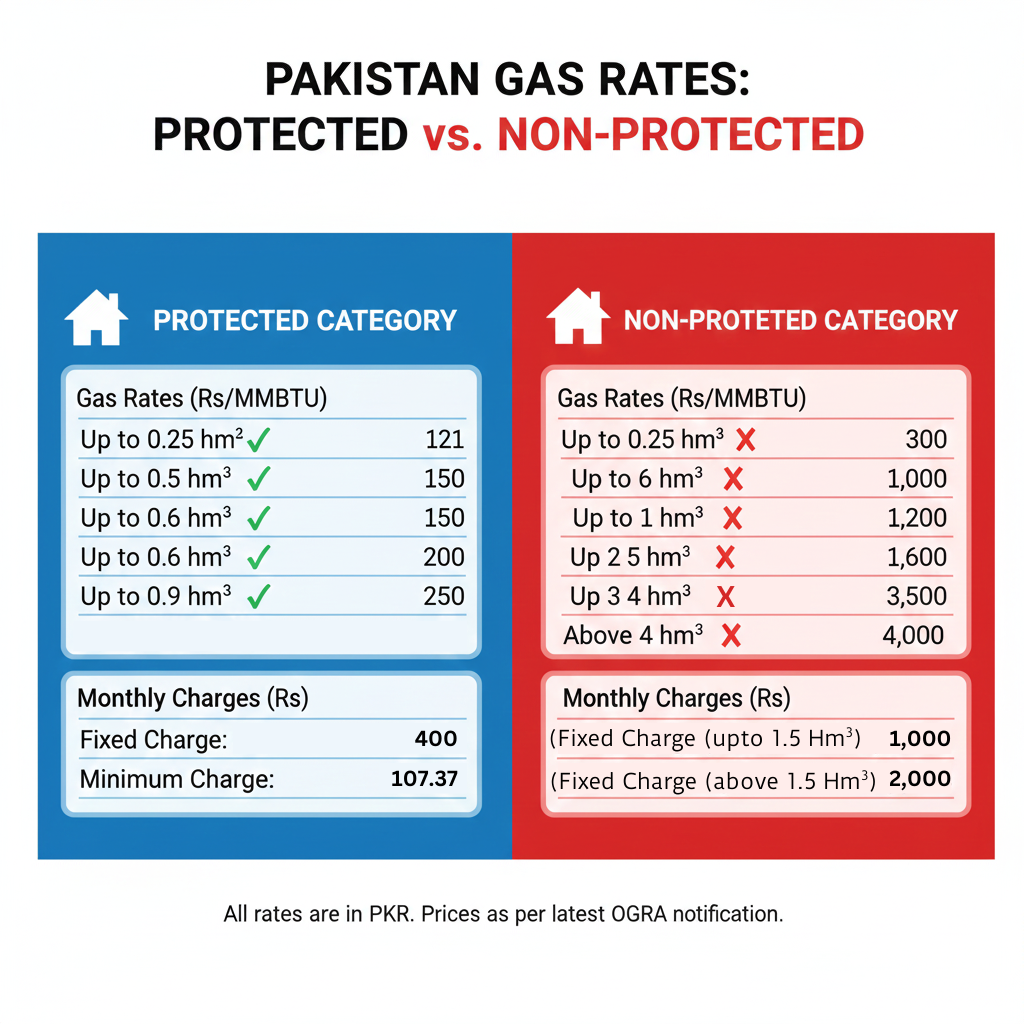
Gas Rates for Protected Category (Rs/MMBTU)
Protected consumers pay the following rates based on monthly consumption:
- Up to 0.25 hm³: Rs 121
- Up to 0.5 hm³: Rs 150
- Up to 0.6 hm³: Rs 200
- Up to 0.9 hm³: Rs 250
In addition, protected consumers pay a fixed monthly charge of Rs 400.
There are also minimum monthly charges of Rs 107.37, even if consumption is very low.
Gas Rates for Non-Protected Category (Rs/MMBTU)
Non-protected consumers face much higher rates as consumption increases:
- Up to 0.25 hm³: Rs 300
- Up to 0.6 hm³: Rs 600
- Up to 1 hm³: Rs 1,000
- Up to 1.5 hm³: Rs 1,200
- Up to 2 hm³: Rs 1,600
- Up to 3 hm³: Rs 3,000
- Up to 4 hm³: Rs 3,500
- Above 4 hm³: Rs 4,000
Fixed charges for non-protected consumers are also higher:
- Rs 1,000 per month for usage up to 1.5 hm³
- Rs 2,000 per month if consumption exceeds 1.5 hm³
Minimum monthly charges still apply even if usage is low.
One Preceding Slab Benefit Explained
An important point mentioned in the official notification is the preceding slab benefit.
For domestic consumers (except those above 4 hm³), one preceding slab benefit is available. This means if you slightly exceed a slab, part of your consumption may still be billed at the lower slab rate instead of the highest rate.
However, once consumption goes above 4 hm³, this benefit no longer applies, and the highest rate is charged.
How SNGPL Determines Your Category
Your category is not decided manually or by request. SNGPL determines your category automatically based on meter readings and average winter consumption.
Key points:
- Your category can change from month to month
- Winter usage plays a major role
- No application or complaint can change your category manually
If your usage goes down, you can return to the SNGPL protected category automatically in future billing cycles.
Why Many Households Lose Protected Status in Winter
Most households lose protected status due to winter habits, such as:
- Continuous gas heater usage
- Longer geyser operating hours
- Increased cooking at home
Even a moderate increase can push usage beyond 0.9 hm³, moving the household into non-protected slabs where rates rise sharply.
How to Stay in the SNGPL Protected Category
Staying protected is possible with small, practical steps:
- Limit gas heater usage and avoid overnight operation
- Reduce geyser temperature and switch it off when not needed
- Avoid running multiple gas appliances at the same time
- Service burners and geysers before winter to avoid wastage
- Monitor monthly consumption through your gas bill
These steps help control usage without compromising basic comfort.
Common Misunderstandings About Gas Categories
Many consumers believe that once they move to non-protected status, they cannot return. This is incorrect. The category resets based on usage.
Another misconception is that SNGPL changes categories intentionally. In reality, the system is consumption-based and automated.
Understanding these facts helps avoid unnecessary complaints and confusion.
Why This Difference Matters for Your Gas Bill
The difference between protected and non-protected categories can mean thousands of rupees in annual gas expenses. Protected consumers benefit from lower rates and stability, while non-protected consumers must manage usage carefully to avoid high bills.
Knowing where you stand helps you plan gas usage, especially during winter months.
Conclusion
The SNGPL protected category exists to protect low-consumption households by offering lower gas rates and reduced fixed charges. Non-protected consumers pay higher rates due to increased usage, especially when consumption crosses winter thresholds.
By understanding official slabs, fixed charges, and consumption limits, households can make informed decisions and avoid sudden bill shocks. Small changes in usage can make a big difference in staying protected.